
Butte County Wanted List Status
Butte County has no official sheriff's most-wanted list that we could find. The county site shows none. The sheriff's own pages show none. That leaves no verified count, schedule, photo policy, or reward offer to report. This gap matters. It keeps an old aggregator page, a random social post, or a stale booking photo from passing as a live sheriff notice.
A wanted list, where one exists, is a curated notice. It is not a full warrant index. Names come and go as cases move, so an old entry may mean nothing today. A missing name proves even less. A warrant can still exist without ever appearing online. A warrant is a court order that authorizes an arrest or another stated action. Only the issuing court or the holding agency can confirm its current status.
Verify Butte County Wanted Fields
No official Butte County wanted list has been verified, so there are no live listing fields to reproduce. If the sheriff's office publishes one later, check the publisher, the date, and the case details at the government source first. The table below spells out what a future listing would need before it earns confidence. It makes no claim that BCSO currently publishes these items.
| Possible field | What must be verified |
|---|---|
| Name and identifiers | Confirm spelling, age or birth information, and another identifier. Similar names can refer to different people. |
| Photograph | Check that the image came from the named agency and belongs to the current notice. A prior booking photo does not prove a live warrant. |
| Warrant or case number | Use the number with the issuing court or counsel. A repost may omit a recall, quash order, or later case event. |
| Alleged offense | Treat the wording as an charge. Filed counts and final disposition may differ from an initial arrest basis. |
| Publication date | Look for both the original date and a current update stamp. Undated copies are poor evidence of present status. |
| Safety or contact direction | Follow only contact instructions published by the responsible agency. Do not approach, follow, restrain, or confront anyone. |
One candidate tool stands out: the official-linked BCSO Public Logs interface. It is the only general public-log tool connected to the sheriff's office that a visitor will run into.
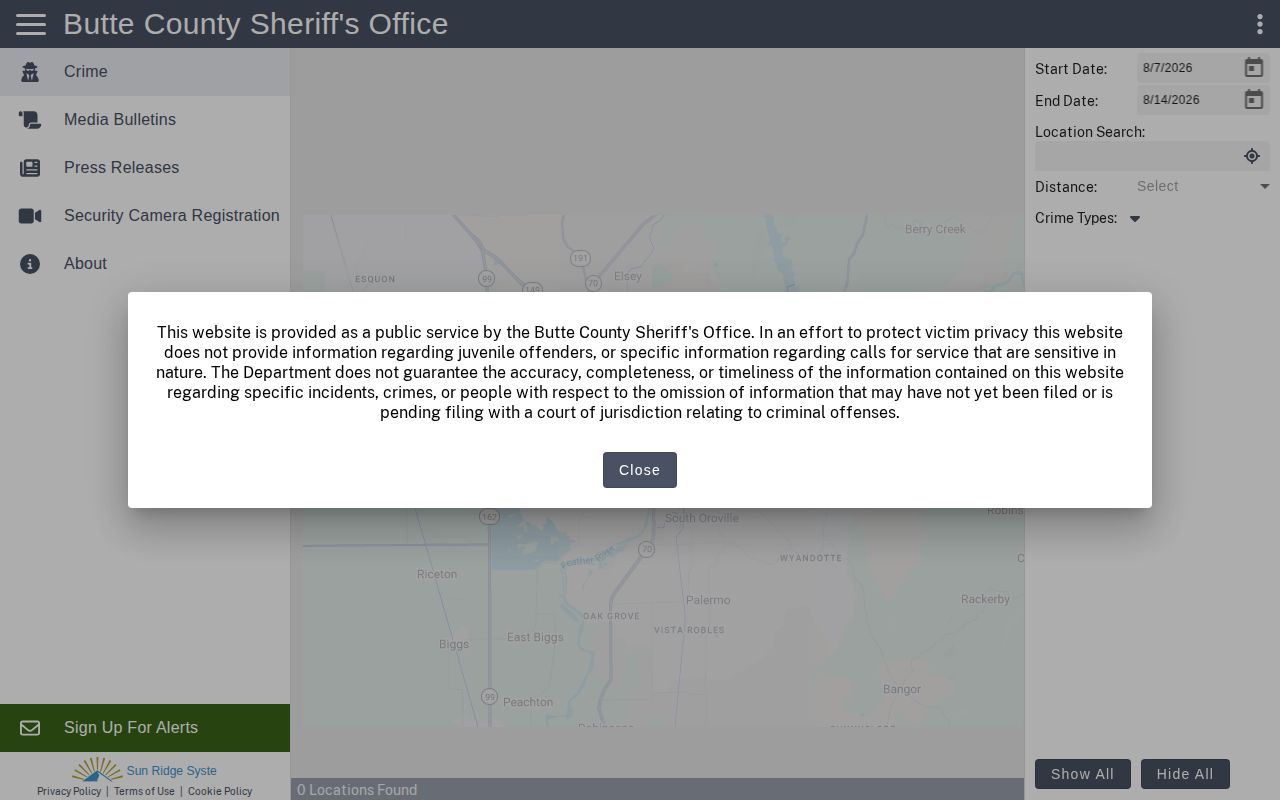
Do not mistake that interface for a warrant search or a wanted gallery. Its existence proves neither one. Only its live functions can say what it actually does.
Read Butte County Wanted Notices
Any trustworthy wanted notice starts at an official government channel. Copies travel badly. They lose dates, warnings, corrections, and removal updates along the way. Work from the original source whenever a BCSO notice, court notice, or agency bulletin appears.
- Open the originating source. Follow the item back to a Butte County government or named law-enforcement page. Do not rely on a cropped image or copied caption.
- Check the date and scope. Determine when it was posted, whether it says the notice is current, and which agency or court issued the underlying warrant.
- Match more than a face. Compare the full name and any official identifiers. A booking image may be old and is not enough for identification.
- Recheck official status. Use the issuing court, attorney, or directing agency before treating the notice as active. Do not infer status from absence or silence.
- Respond safely. Call 911 for immediate danger. Otherwise provide information to the responsible agency without approaching or alerting the person.
After a reported arrest, the county's official booking-record paths may help confirm a later booking. A booking log records an admission event, nothing more. Court records show what happened next.
Butte County Wanted Safety
No verified Butte County most-wanted tip line, anonymity policy, or reward program turned up. Inventing one, or copying a number from some other county, would be reckless. Emergencies and routine reports go through different channels. One caution: skip Butte County Connect for crime tips. The county calls it a general issue-reporting service, not a crime-reporting or inmate tool.
Immediate danger: 911
Butte County non-emergency reporting: 530-538-7322
Butte County Sheriff's Office main line: 530-552-5300
BCSO Records/CCW: 530-552-5200
When you call, stick to facts. Give the location, the time, the direction of travel, and what raised the concern. Assume nothing about rewards or anonymity. A dispatcher or investigator can explain how the process works. Never enter private property, track a device, impersonate an officer, publish a home address, or try to detain someone yourself.
Check a Butte County Warrant
No dedicated Butte County warrant-search page could be verified, and the public logs tool is not documented well enough to claim a warrant tab. Anyone worried about their own status should work through counsel or the issuing court rather than a web search. The Butte Superior Court Criminal Division handles county felony and misdemeanor matters at One Court Street in Oroville. Its clerk line is 530-532-7011.
- Collect accurate case details. Write down the full legal name, date of birth, possible case number, issuing court, and any notice received. Do not send identity documents to an unknown site.
- Speak with an attorney. Counsel can confirm the correct court, review the record, explain rights, and arrange a lawful response without creating needless risk.
- Contact the issuing court. Ask the criminal clerk what public case information is available and which official procedure applies. Court staff provide procedure, not personal legal advice.
- Use BCSO for routing. Records or the non-emergency channel can direct procedural questions to the right unit. Do not assume staff can give legal advice or promise an outcome.
- Resolve through the stated process. Follow counsel and court instructions for appearance, calendar placement, or surrender. Do not provoke police contact to “test” a warrant and do not evade service.
Court records carry real weight. A judge can recall or quash a warrant. Quash just means canceling its legal force. An unofficial page may never catch that change, so a direct court check or an attorney beats a name-only web result every time.
Online court information helps you spot a public case, but it has limits. Sealed and confidential matters stay hidden. Similar names demand careful matching, and entries can lag behind courtroom events. A blank search is not proof that no warrant exists. Start with the court named on any citation, notice, release paper, or prior case record. If the issuing jurisdiction is unclear, counsel can trace it without leaning on a speculative people-search site. Keep notes on the office contacted, the date, and any case number given. That paper trail makes follow-up easier and keeps the effort pointed at lawful resolution.
Butte County Warrant Types
A warrant's label tells you why it was issued. Treat these as general definitions, not descriptions of any Butte County web portal. In every case, the issuing paperwork and the court docket control.
| Type | General meaning | Safe response |
|---|---|---|
| Arrest warrant | A judge authorizes an arrest based on a sworn showing or filed case. | Have counsel confirm the court and arrange the proper response. |
| Bench warrant | A court issues it after a missed appearance or failure to comply with a court order. | Ask counsel or the criminal clerk about the required court procedure. |
| Search warrant | A judge authorizes a search of a stated place, person, or property for described evidence. | Seek legal advice about the order; do not obstruct officers. |
| Out-of-county warrant | Another court or agency may be responsible even if contact occurs in Butte County. | Confirm the issuing jurisdiction before relying on local web results. |
Plenty of people assume a warrant means a charge or a conviction. It means neither. It is a court order, and plenty of them never show up on any public wanted list at all. Status shifts fast, too. A court appearance, a payment, a recall, or almost any later order can change things, so always confirm before acting on old information.
Where the warrant came from matters just as much. Cities issue them, other California counties issue them, and so do courts outside the state. BCSO might run into one of those orders locally while the actual case belongs to a different agency entirely. Read the notice closely. The issuing court and agency are printed on it, and that tells you who to call. Skipping this step can tangle a Butte County arrest or booking with a warrant that started somewhere else entirely.
Butte County Alerts Are Separate
The county runs several alert systems. None doubles as a most-wanted feed. VINE sends custody and court updates about a person you already know. Smart911/RAVE handles emergency notices. Meanwhile, Butte County Connect takes general county issue reports. Some cities offer CitizenRIMS tools with crime or event alerts. Treat all of these as what they are. None functions as a complete warrant checker, mugshot alert service, or sheriff's wanted list.
Sheriff media releases tell stories on no set schedule. So there is no dependable mugshot rhythm to watch. State law adds a wrinkle. California Government Code § 7923.611 restricts how agencies share booking photos on social media. A department's social feed is not an arrest database. When legal status is the question, the issuing court holds the answer.
Note: A deleted post may reflect a policy limit or a case update, so its absence alone says nothing about warrant status.